The Ballad of the Last Bastion
“Gather ‘round the hearth, travelers, for the wind outside has a bitter bite tonight—a bite that reminds me of a time when the sea didn’t just bring fish, but fire. I am Finnian, a wanderer of the silver tongue, and I bring you the chronicle of Glenmore. It is a village perched on the jagged edge of the Irish coast, where the Atlantic doesn’t just meet the shore; it wars with it.”
— Finnian the Bard
The Shadow on the Horizon
In the days before the iron hit the sand, the sky turned the color of a bruised plum. The tides didn’t just roll; they groaned. The local fishermen, men with skin like cured leather, saw them first: the dragon-headed prows of the Northmen. These were the wolves of the waves, Norsemen forged in frost, coming to reap what they had not sown.
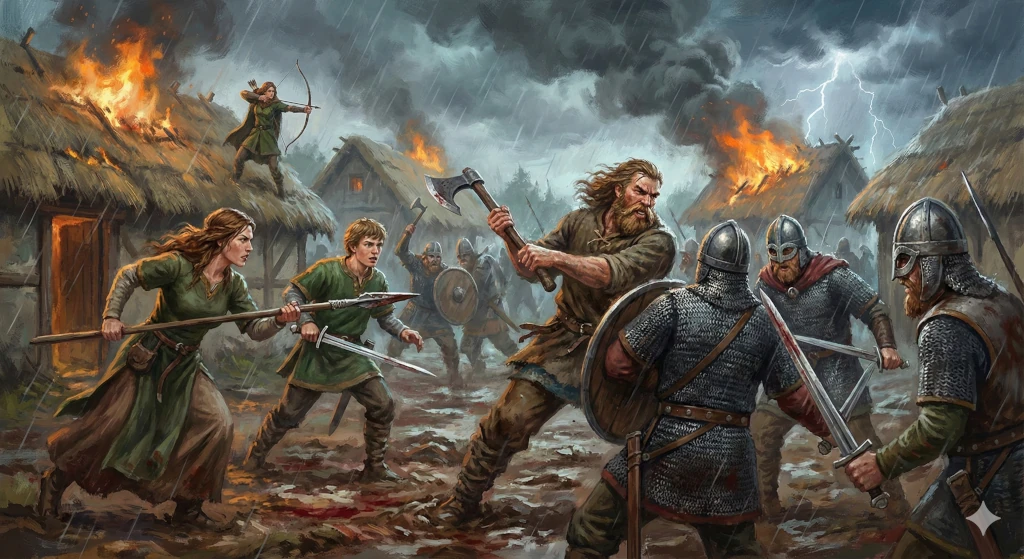
In the heart of Glenmore lived the Clan O’Shea. There was Connor, the patriarch, a man whose shoulders seemed carved from the very cliffs of Moher; his wife, Morna, with eyes like flint and a heart of tempered steel; and their kin, young Liam and the keen-eyed Sloane. When the bells of the watchtower rang, they didn’t flee to the hills. They reached for the rack.
The Calm Before the Storm
Preparation was a fever. We didn’t have a king’s army, but we had the desperate strength of those who have everything to lose. Connor spent the nights teaching farmers how to hold a spear so it wouldn’t shatter against a shield.
“Steel is cold,” Connor would roar over the wind, “but the blood in your veins is a furnace! Stand firm, and the Northmen will find only a wall of Irish oak!”
While Liam sharpened a short sword by the whetstone, Sloane was a shadow in the high lofts, fletching arrows with goose feathers and dipping the tips in resin. Morna moved among the village women, not with tears, but with bandages and buckets of pitch, preparing the “Welcome” the invaders deserved.
The Battle of the Red Tide
The attack came at the “Grey Hour”—that moment before dawn when the world is ghost-white. Out of the mist, the Viking longships ground against the shingle. Huge, fur-clad warriors leaped into the surf, their war-cries drowning out the gulls.
The first wave hit our makeshift barricades like a hammer. The battle was a chaos of mud and iron. * Connor stood at the center of the shield wall. A giant of a Viking, bearded in red, swung a heavy Dane axe at him. Connor didn’t flinch; he caught the blow on his bossed shield, the wood splintering, and drove his own blade into the gap in the Norseman’s mail.
Liam was a whirlwind at his father’s flank. He was smaller, faster. When a raider tried to sweep Connor’s legs, Liam dived forward, his short sword finding the soft leather of the invader’s greaves.
From the rooftops, Sloane’s bow sang a deadly rhythm. Twang-thud. A Viking helmsman fell. Twang-thud. A torch-bearer was quenched before he could reach the thatched roofs.
The Breach and the Mother’s Fury
The turning point came when a group of “Berserkers”—men possessed by a frenzied bloodlust—broke through the river-gate. They swarmed into the narrow alleys, aiming for the church where the elders hid.
Liam found himself cornered by three of them. His sword was notched, his breath coming in ragged gasps. As the lead Viking raised a jagged seax to finish the lad, a shadow darted from the doorway of the O’Shea cottage.
It was Morna. She didn’t carry a sword of legend, but a heavy, boar-hunting spear. With a cry that started in her soul, she lunged, the point catching the raider under the ribs. She didn’t stop. She drove the weight of her entire life—her love for her son, her pride for her home—into the strike. The Vikings, shocked by the ferocity of a “mere healer,” hesitated. That second was all Connor needed to bring the rest of the line crashing down on their rear.
5. The Song of Victory
By the time the sun fully broke the horizon, the tide was retreating, and the Vikings went with it. Their numbers were thinned, their pride broken against the rocks of Glenmore. They left behind broken oars and shattered shields, fleeing back to the cold safety of the deep sea.
The night that followed was quiet, save for the crackle of the watch-fires. There was weeping for the fallen, yes, but there was a new light in the eyes of the survivors. The O’Shea family sat together by the embers, bruised and bloodied, but unbroken.
And so, I sing this for you. Remember:
A wall of stone can be toppled, but a wall of kin, bound by the spirit of the land, is a fortress no Northman can ever truly conquer.