The Breath of Aeons
The Petrified Valley did not smell of rot, but of finished things. The air was dry, a static suspension of dust that coated the back of the throat like ground glass. Elara Vance adjusted the straps of her pack, checking the Chronometer on her wrist. The hands didn’t tick; they swept in uneven, lurching circles, agitated by the ambient temporal radiation.
“Readings are spiking,” she said. Her voice was flat, absorbing the silence rather than breaking it. “Gradient is steepening. We are close.”
Behind her, Kael stumbled on a ridge of shale. He breathed heavily, the sound loud in the unnatural stillness. Elara noted his fatigue as a variable: Stamina depleting. Efficiency reducing by twelve percent.
“Elara, look,” Kael whispered.
He pointed to a patch of ground ten meters ahead. It was a perfect circle of green—lush, vibrant grass and a single sapling exploding from the grey rock. As they watched, the sapling shot upward, bark thickening, leaves unfurling and yellowing in seconds. It became a towering oak, then a gnarled elder, then a rot-hollowed husk. It collapsed into a heap of sawdust and lichen.
A deer, panicked by their presence, bounded from behind a boulder. It leaped into the zone. Mid-air, its fur greyed. Its flesh desiccated. It landed not as a beast, but as a scatter of bleached bones.
“Time Pockets,” Elara noted, stepping around the perimeter. “Residual exhalations. Avoid them.”
“We should turn back,” Kael said. He stood frozen, staring at the white ribs of the deer. “This isn’t an archive, Elara. It’s a graveyard. The risk exceeds the projection.”
Elara didn’t look back. She continued her ascent, eyes scanning the strata of the canyon walls—mudstone next to obsidian, a geological impossibility. “The Guild requires the Prophecy Data. A war is calculating itself on the horizon. To prevent it, we need the outcome. The variable of fear is irrelevant.”
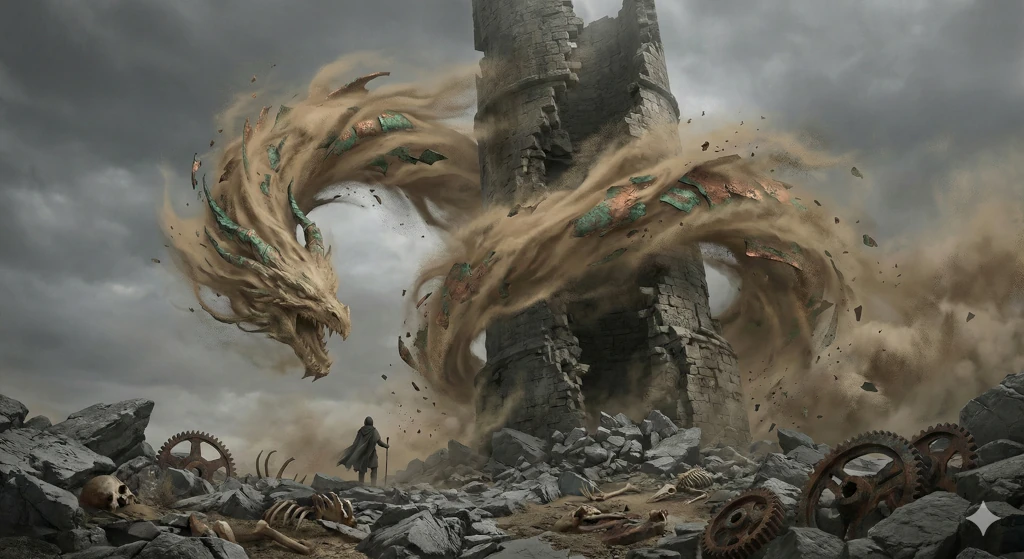
They found the Chronos Wyrm at the apex of the valley. It lay coiled atop a spire of sandstone that was visibly eroding, grains cascading down like an hourglass. The beast was vast, its scales the color of oxidized copper and desert sand. They shifted constantly, granular and fluid, as if the creature were made of a billion separate particles held together by will alone.
It slept. The silence around it was heavy, a physical pressure that pressed against the eardrums.
Elara set down her pack. She moved with practiced economy, assembling the Temporal Mirror. The tripod legs bit into the rock. The lens, a composite of quartz and time-dilated crystal, gleamed dully.
“Setup complete,” she murmured. “Target acquisition locked.”
She turned to Kael. He was standing near the edge of the spire, watching the dragon’s flank rise and fall. The movement was slow, tectonic.
“Kael. Take the flare pistol. Move to the northern ridge. Fire across its nose.”
Kael turned, his face pale under the layer of valley dust. “You want to wake it? Elara, it’s not a machine. It’s a force. If it breathes—”
“If it breathes, the Mirror captures the refraction of the temporal stream. We see the future. We solve the equation of the war. Move.”
“No.” Kael dropped his pack. The thud was swallowed by the silence. “I won’t do it. We’re trespassing on time itself.”
Elara looked at him. His chest heaved. Sweat cut tracks through the grey dust on his forehead. Heart rate elevated. Irrational resistance.
She didn’t argue. She didn’t plead. The calculation was already finished.
Kael turned away, looking back toward the descent, assuming the debate was over—assuming his refusal had weight.
Elara reached into her belt. The motion was smooth, mechanical. She drew the flare pistol.
The click of the hammer cocking was the loudest sound in the valley.
Kael spun back, eyes widening. “Elara?”
She fired.
The magnesium star hissed through the air, burning with a harsh white light. It popped directly above the Wyrm’s head.
The dragon did not roar. It did not snarl. It simply opened its eyes—pools of milky entropy—and uncoiled. The sound was a rushing wind, a susurrus of sliding sand, a billion grains of time sliding down a dune.
It rose, blotting out the sun. The world turned grey, the color drained away by the sheer gravitational pull of its existence.
“Mirror aligned,” Elara said, her hands steady on the controls.
The Wyrm opened its jaws. It inhaled. The atmosphere shrieked as it was pulled into the void. Then, the exhalation.
It was a stream of distortion. The air rippled, not with heat, but with age.
Elara adjusted the focal length. “Data stream incoming.”
The stream shifted. The dragon turned its head. The cone of accelerated decay swept toward them.
“Elara!”
Kael collided with her. It wasn’t a hero’s shove; it was a desperate, flailing tackle. She lost her footing, stumbling away from the Mirror, skidding on the loose shale.
Kael stood in the path, arms raised, a fragile barrier against the inevitable.
The breath hit him.
There was no fire. There was no blood. Kael’s scream was a sound of absolute confusion that aged into a rattle.
In the first second, his jacket frayed, the fibers unspooling into grey lint. In the second, his skin drank the years, drying instantly, pores stretching into ravines. In the third, his eyes clouded with cataracts, blinding him to his own end. In the fourth, his scream became a wheeze as his lungs lost their elasticity. In the fifth, he fell, a heap of brittle limbs. In the sixth, the flesh withered to parchment, tight against the skull. In the seventh, the parchment flaked away, revealing yellowed bone. In the eighth, the skeleton collapsed, disjointed by the weight of gravity. In the ninth, the bones shattered into powder, a lifetime ground down to grit. In the tenth, the wind took him.
Elara scrambled up. She did not look at the dust. She lunged for the Mirror, thrusting it into the edge of the dissipating breath.
“Recording,” she gasped.
The surface of the Mirror swirled. The glass screamed as the temporal load hit it. Elara looked into the depths.
She saw the valley. She saw the stone erode to a plain. She saw cities rise from the plain, glittering spires of glass and light. She saw them burn. She saw new forests grow over the ruins. She saw the forests die. She saw the sun expand, a red giant swallowing the sky. She saw the Guild, her life’s work, reduced to a footnote, then to nothing.
The glass cracked. The frame rusted instantly, turning orange and flaky. The device disintegrated in her hands, crumbling into a pile of oxidized metal and silica dust.
The Wyrm beat its wings—once, twice—and ascended. It left no wake, only a stillness that felt final.
Elara stood alone on the spire.
She looked at her hands. The skin was paper-thin, spotted with liver marks. Her knuckles were swollen knobs. A lock of hair fell across her face; it was grey.
Estimated biological decay: twenty years. Elara calculated instinctively. Operational efficiency reduced by forty percent.
The thought was cold, but her hands were shaking.
She turned to the spot where the Mirror had been. A pile of rust. The data core was gone, decomposed into base elements. The equation remained unsolved.
She turned to the spot where Kael had been.
A mound of grey dust, shaped vaguely like a person, began to disperse in the wind.
Elara sat. The stone was cold.
She reached out, her trembling fingers brushing the dust of her apprentice. It felt dry. Gritty. Final.
There was no prophecy to save them. There was only the wind, and the silence of finished things.
Slowly, painfully, Elara Vance stood up. The joints of her knees popped, a sound like dry twigs snapping. She wore the clothes of a young woman, hanging loose on her withered frame.
She turned her back on the empty sky. She began the descent, one step at a time, carrying the heavy, invisible burden of time that she could never give back.