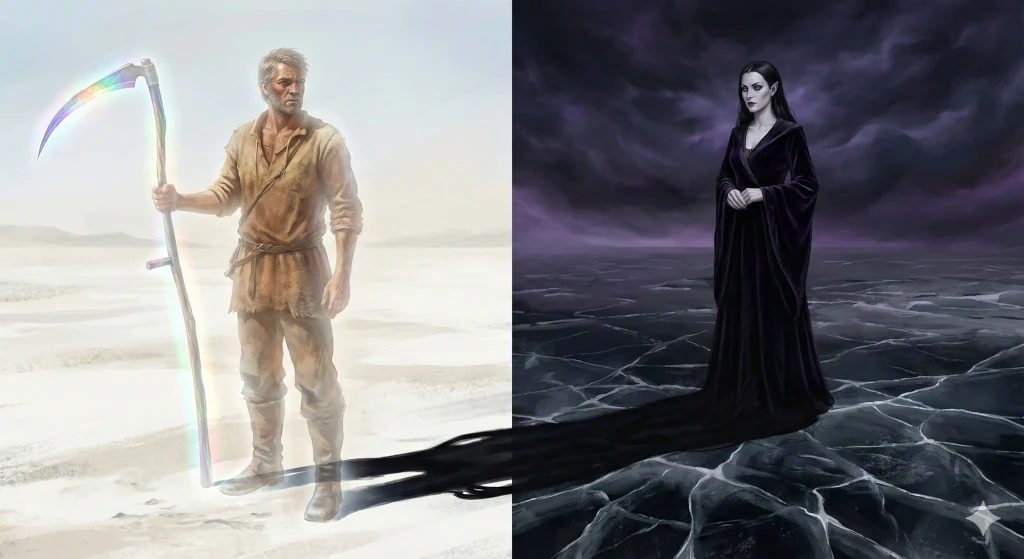
The sun did not shine; it appraised.
It was a celestial hammer, beating the world into submission until every edge was sharp, every surface bleached, and every secret exposed. In the fields of Solara, the light did not nourish. It sterilized. The soil was white dust, the crops were crystalline growths that chimed in the wind like dropped coins, and the farmers were translucent ghosts of men.
Kael was one such ghost. He stood knee-deep in the photic grain, his prismatic scythe rising and falling with the rhythm of a pendulum counting down to zero. The light was abrasive against his skin, a constant friction that wore him down, layer by layer. He did not sweat. Moisture had long since been traded for endurance.
He looked at his feet. The shadow anchored there was a pathetic thing—tattered, gray, barely staining the white earth. It was the currency of a pauper. In this world, wealth was measured in opacity. The Merchant Lords hoarded silhouettes of heavy, viscous ink that dragged behind them like royal trains. Kael’s shadow was mere mist, easily depreciated by the noon glare.
He harvested the light, yet he possessed none of the dark.
A bell tolled from the city ramparts, the sound thin and brittle in the heat. It was the signal for the Solstice Market. Kael paused, leaning on his scythe. The handle was warm, vibrating with the captured luminance of the harvest. Today, the Merchant Lord Vane would liquidate his assets.
Today, the Princess Elara would be sold.
Kael closed his eyes, but the red glare of the sun pierced his eyelids. He remembered her not as she was—a captive in a gilded cage—but as a sensation of coolness. A memory of velvet. She was the last of the Nocturnals, a lineage of vampires who drank not blood, but the absence of light. To stand near her was to feel the relief of a cloud passing over a scorching desert. She was heavy with history, her shadow a pool of deep, cooling oil in a world of parched dust.
He had nothing to offer her but his poverty. Yet, the ledger of his heart demanded he try. He would bankrupt his existence for a single moment of her freedom.
He sheathed his scythe and turned toward the city. The light pushed against him, a physical wall he had to wade through. He was light, too light. The wind threatened to lift him, to scatter him like the dust of the fields. He walked carefully, placing each foot with deliberate intent, forcing his gray shadow to grip the ground.
The auction hall was a cathedral of mirrors. Light was magnified, bounced, and concentrated until the air shimmered with heat. The wealthy attendees wore suits of woven obsidian to protect their precious shadows from the glare. They stood in circles, their darkness pooling around their boots, heavy and rich.
Kael stood at the periphery. He was invisible to them, a rounding error on the floor.
On the dais, the Merchant Lord Vane sweated. His own shadow was shrinking, his debts eating away at his substance. He gestured to the cage in the center.
“Lot 404: The Jewel of the Night,” Vane announced. His voice trembled. “The Princess Elara.”
The cover was pulled back. The crowd gasped, not in awe, but in speculative greed.
Elara sat in the center of the cage, her skin like porcelain, her eyes like the void between stars. But it was her shadow that captivated them. It did not lie on the floor; it draped over the cage bars, thick and fluid, a cascade of pure, unadulterated midnight. It was worth kingdoms. It was worth immortality.
“Opening bid is five thousand yards of dusk,” Vane cried.
A Shadow Eater, a creature of bloat and hunger, stepped forward. “Six thousand,” he rasped. His shadow rippled with the faces of those he had consumed.
Kael stepped forward. The movement was slight, but the light caught the prism of his scythe, sending a fractured rainbow across the floor. The room fell silent. A pauper interrupting the trade of kings.
“I offer…” Kael began, his voice dry as parchment. He reached into his pocket and pulled out a small glass vial. Inside swirled a gray mist—his savings. Years of scraped-together shade. “I offer all that I am.”
Laughter erupted. It was a sharp, crystalline sound, shattering the tension.
“You offer dust,” Vane sneered. “You offer a breath of gray when we demand the weight of the abyss. Begone, sun-farmer. Unless you can pay in Umbra Aeterna.”
The room quieted. The Umbra Aeterna. The Eternal Shadow. It was a myth, a singularity of darkness found only in the deepest receded corners of the Eclipse Lands. It was not merely the absence of light; it was the annihilation of it.
“Bring me the Umbra,” Vane mocked, “and she is yours. Fail, and she goes to the Eater.”
Kael looked at Elara. She did not look at him. She looked at the floor, resigning herself to the calculation of fate. But Kael saw the tremor in her darkness, the way her shadow recoiled from the light.
“Accepted,” Kael whispered.
The contract was struck. The air grew heavy with the binding. He had until the gavel fell on the final sale at sunset.
The journey to the Eclipse Lands was a descent into subtraction.
As Kael traveled north, the sun lowered, not setting, but receding behind the great celestial blockage. The light lost its heat, then its color, fading from blinding white to bruised purple, and finally to a sterile gray.
The cold was instantaneous. It was not a drop in temperature; it was an extraction. The heat was taxed from his body, pulled out to pay the debt of the freezing air. Kael’s breath misted and froze, falling as tiny diamonds.
He walked on the edge of the world. Here, the ground was not dust, but ice—black, hard, and reflective.
His shadow began to rebel.
In the sun-fields, his shadow was a slave, burned into submission. Here, in the twilight, it sensed the call of the deep dark. It stretched, pulling at his heels, trying to detach and flee into the void.
Kael stumbled as his own silhouette tripped him. He fell to the ice, the cold biting into his hands. He looked back. His shadow was tearing at the seam of his boots, a gray ragged thing desperate for liberation.
“Not yet,” Kael gritted out.
He took a needle from his pack—a needle of bone—and a spool of silver thread. He sat on the ice, shivering violently, and pierced the heel of his own shadow. He sewed it to the sole of his boot. The needle went through the gray film and into the leather, binding the metaphysical to the physical. He stitched with frantic precision, ignoring the nausea that came with pinning his soul to the earth.
When he stood, his shadow dragged, sullen and heavy, but it held.
He walked on. The silence was absolute. It was a silence that demanded payment in noise, swallowing the crunch of his boots before the sound could fully form.
Then, the Wraiths came.
They were not solid. They were sketches of hunger drawn on the air, cosmic debt collectors seeking the currency of the mind. They swarmed Kael, ignoring his body, diving for the vault of his consciousness.
Kael swung his scythe. The prismatic blade sliced through them, but they reformed instantly. They did not bleed; they only faded and returned.
One passed through his chest. Kael gasped. A memory vanished—the taste of an apple he had eaten ten years ago. Foreclosed. Replaced by a hollow static.
Another dove. The face of his mother. Repossessed. He could not recall her features, only the shape of the loss.
They were auditing his identity, stripping away the assets of his self.
“Take it!” Kael screamed. He stopped fighting. He closed his eyes and summoned a memory he held dear—a memory of sitting by a river, the sun warm but not burning, a moment of peace before the labor of his life began. It was a bright, heavy coin of memory.
He projected it outward, offering it to the void.
The Wraiths shrieked, a sound like tearing metal, and swarmed the memory. They tore it apart, devouring the sensation of the river, the smell of the grass, the peace.
While they feasted on his past, Kael ran toward the future. He paid the price of his history to purchase his passage. He ran until his mind was a ledger of blank pages, ran until the ice turned to nothingness.
He reached the epicenter.
The Umbra Aeterna was not a rock. It was a deficit in the universe.
It hovered in the center of a crater, a sphere of absolute negation. It did not reflect; it drank. Looking at it was like looking into an open eye that refused to blink.
But it was not unguarded.
Orbiting the sphere was the Luminari.
It was a construct of the Old Light—the light before the sun became hostile. It was a being of pure, searing geometry, a star constrained into the shape of a sentinel. It revolved around the Umbra, its beams sweeping the crater. Where the light touched the black ice, the ice screamed and evaporated.
Kael hid behind a ridge of frozen obsidian. He was too faded to sneak. His gray shadow would stand out against the black ice like a beacon. He was too weak to fight. The Luminari would incinerate him before he could lift his scythe.
He watched the beam. It was a scanner, assessing the value of matter and burning away the worthless.
He looked at the Umbra. It was the price of Elara. It was the coin that would buy her life.
He realized then the cruelty of the transaction. You could not steal the shadow. You could not mine it. You had to create it.
The Luminari was not just a guard; it was the mint.
Kael stood up. He held his prismatic scythe in his right hand. He checked the stitches on his heels. They were tight.
He stepped out from the ridge.
The Luminari stopped its rotation. The great eye of light focused on him.
Kael did not run. He walked directly into the beam.
The pain was not of heat, but of appraisal. The light saw him. It saw every flaw, every weakness, every empty space where his memories used to be. It tallied his worth. It burned away the pretenses. It burned away his clothes, his skin, his very surface.
“I am Kael!” he screamed, though he had no voice left to spend. “I am the caster!”
He stood in the center of the holy fire. And behind him, cast by the intensity of the Luminari, a shadow formed.
It was not the gray tatter of a sun-farmer. It was hard. It was sharp. It was absolute. The light was so bright, so overwhelming, that the shadow it cast was the darkest thing in existence. It was the Umbra Aeterna, born from the obstruction of Kael’s body against the divine light.
It stretched out behind him, a long, black road of infinity.
Kael raised the scythe. The blade was made to cut light, but now it would cut the dark.
He swung.
The blade bit into the connection between his heels and the shadow. It met resistance—a deep, magnetic pull, as if he were trying to cut gravity itself. The universe screamed in protest at the severance. It was a violation of the natural law that bound object to image.
Kael pulled. His muscles tore. The stitches in his boots snapped, one by one.
With a sound like a cracking glacier, the bond broke.
The shadow snapped free. It coiled instantly, a living fluid, rolling into itself like a drop of mercury on a hot pan. It tried to return to the void, to flee the light that had birthed it.
Kael was falling, his weight evaporating, but his hand moved with the desperate speed of a dying man. He threw the containment jar—a vessel of lead and glass.
The shadow swirled, caught in the vacuum of the jar’s mouth. Kael slammed the lid shut.
The Umbra was captured. The asset was secured.
Kael hit the ground, but there was no impact. He was light as dandelion fluff.
He looked at his feet. There was nothing. The light of the Luminari beat down on him, but he cast no shadow. The light passed through him as if he were glass. As if he were air.
He was shadowless. He was untethered.
He began to float.
He did not walk back to the city; he drifted.
He was a leaf caught in the draft of the world’s breathing. He had to claw at the ground to pull himself forward, for gravity had lost its claim on him. He was becoming transparent, a smudge on the lens of the world.
The sun was setting as he reached the gates. The Solstice Market was concluding.
He burst into the hall, a gust of wind that smelled of ozone and void. The doors slammed open, not by his strength, but by the vacuum of his presence.
The auctioneer raised his gavel. “Going to the Shadow Eater for seven thousand—”
“Paid!”
The voice was a whisper that echoed like a shout. Kael stood in the doorway. He was barely visible, a shimmering outline of a man. The light of the chandeliers passed right through him.
He held up the jar.
Inside, the Umbra Aeterna swirled. It was so dark it made the room feel dim. It sucked the light from the candles, plunging the hall into a sudden, terrified twilight.
The Shadow Eater hissed and recoiled, shielding its eyes from the purity of the darkness.
Vane turned pale. He looked at the jar, then at the fading ghost of the man holding it.
“The Umbra,” Vane gasped. “It is real.”
Kael rolled the jar across the floor. It sounded like a stone rolling on a tomb. It stopped at Vane’s feet.
“The price is paid,” Kael said. “Release her.”
Vane scrambled to pick up the jar. He held it like a holy relic. The value within was incalculable. It was enough to buy a city, a kingdom, a new sun.
“Release her!” Vane screamed to the guards.
The cage was unlocked. Elara stepped out.
She did not look at the Merchant. She did not look at the Shadow Eater. She looked at Kael.
She saw the light passing through his chest. She saw the space beneath his boots where the darkness should have been. She saw the cost.
“Kael,” she breathed.
She ran to him. But when she reached for his hand, her fingers passed through his skin like smoke. He was dissolving. The world was rejecting him. He had no currency left to pay for his space in reality.
“I am bankrupt,” Kael smiled, and the smile was a fading ripple in the air. “I have spent it all.”
“No,” Elara said. Her voice was steel. “You have simply changed vaults.”
She stepped closer. She was heavy with shadow, rich with the ancient darkness of her line. She stood before him, blocking the chandelier’s light.
She cast her shadow over him.
It fell upon him like a cloak. It was cool, heavy, and substantive.
And in the darkness of her shadow, Kael became solid. The shade anchored him. The weight of her existence pressed him back into the world. He fell to his knees, gasping, feeling the floor beneath him again.
He could not exist in the light. But he could exist in her dark.
They left the city of Solara. They left the sun-fields and the auction halls.
They walked to the Twilight Borderlands, the thin strip of world between the burning day and the frozen night. It was a land of eternal dusk, where the colors were muted and the wind was still.
Here, they built a home of gray stone.
Kael could never step into the sun again. The light would scour him from existence in seconds. He could never walk alone.
He survived only by standing within Elara’s shadow. Where she walked, he followed, stepping into the silhouette she cast. She was his shield, his anchor, his bank. She paid the gravity tax for both of them.
In the evenings, when the light was lowest, he would sit by the fire—a small, carefully tended flame. He provided the warmth she could not generate. She provided the darkness he could not cast.
They were a closed economy. Two souls balancing the ledger of survival.
He looked at her across the firelight. Her eyes were dark voids, full of stars.
“Is the debt too heavy?” she asked, as she did every night. She watched the way he had to stay close, the way his hand flickered if it strayed too far from her shade.
Kael looked at his hands, solid only because the firelight cast her shadow upon them.
“The price is paid,” he said. “And the account is settled.”
He reached out, and this time, his hand met hers. Warmth met cool. Light met dark.
It was a fair trade.