Chapter 1
The fog in the Sump did not drift; it settled, heavy and wet, a suffocating blanket woven from ozone, sulfur, and the sweat of a million unwashed bodies. It was a physical weight, pressing down on the labyrinth of corrugated tin and rotting brick that made up the city’s bowel.
Silas tasted it on his tongue, a metallic tang that coated the back of his throat. It was a prelude to the meal he did not want but required, a grim appetizer for a starving man. He sat in his niche between two crumbling walls, the damp seeping into the rags that barely covered his wasted frame. His skin was gray, not from dirt, but from a deeper, systemic pallor—the color of ash left in a cold grate.
Hunger was not a hollow in the stomach here. It was a trembling in the blood, a fraying of the nerves that screamed for the weight of another’s sin to anchor them. His hands shook, the tremors rattling his bones against the hard-packed earth. He needed ballast. He needed the leaden heaviness of regret to stop him from floating away into the madness of the starving.
A figure emerged from the smog, materializing like a ghost from the chemical haze. A man, well-dressed in a coat of midnight wool, but trembling so violently the fabric shimmered. Mud from the lower wards stained his polished boots, a mark of shame for venturing this deep. He held his hand out, palm cupped tight against his chest as if protecting a wound. He reeked of fear—sour, acrid, piercing through the ambient stench of the Sump.
“Take it,” the man whispered. His voice was brittle, ready to snap. “Please. It’s heavy. It’s so heavy.”
Silas looked up. His eyes were rheumy, the whites yellowed and webbed with red, but his hand was steady as he reached out. The beggar’s palm was a map of scars and calluses, open and waiting.
The man dropped the coin.
It hit Silas’s palm with a dull thud that belied its size. A Lead Slug. Roughly minted, gray and pitted, the cheapest currency of the Mint. It felt cold, colder than the air, an unnatural chill that sucked the warmth instantly from his skin. It sat there, an ugly, inert lump of metal, yet Silas could feel the vibration of it, a low-frequency hum of misery.
“The price?” Silas croaked. His voice sounded like gravel grinding together, a sound of geological friction.
“Just take it,” the man sobbed, clutching his lapels. “I can’t sleep. I see the water. I see the shoe floating. It won’t stop bobbing.”
Silas nodded slowly. He did not need the details. The metal would tell him everything. It was a transaction of the flesh. He lifted the slug to his lips. It smelled of copper and brackish water, of stagnation and decay. He placed it on his tongue.
It was hard, freezing, and tasted of battery acid. He swallowed.
The reaction was immediate.
Silas gagged. His throat seized as the coin slid down, burning like a coal despite its unnatural chill. It scraped his esophagus, a jagged pill of concentrated trauma. It hit his stomach and dissolved, not into nutrients, but into pure, liquid horror.
The world of the Sump vanished.
Cold. Sudden, shocking cold. The air is gone, replaced by a wall of dark, churning water. Silas—no, not Silas, he is the man in the coat, but younger—is flailing. His hands grip something small. A wrist. A child’s wrist. The skin is slippery, wet. The current is a muscular beast, tearing at them.
He holds on. He tries. But the fear is a rising gorge. If he holds on, he will be pulled under. The darkness below is absolute. The lungs burn, screaming for air. Survival instinct, sharp and reptilian, overrides love.
He lets go.
The release is physical. He kicks upward, breaking the surface, gasping in the sweet, stinging air. He looks down. A red sneaker breaks the surface, bobbing once, twice, a bright spot of color in the gray swirl. Then it is gone. The silence that follows is louder than the roaring river. It is a crushing, absolute silence that fills the ears and never leaves.
Silas convulsed. He curled into a ball in the mud, his spine arching as the memory etched itself into his nervous system. He felt the man’s guilt, the suffocating panic, the icy water filling his own lungs. He gasped, drowning on dry land, his fingers clawing at the dirt, trying to find purchase against a current that wasn’t there.
The man stood over him, watching the beggar writhe. He watched the transfer of his burden. As the convulsions slowed, the man straightened. The trembling ceased. His face smoothed out, the lines of worry erasing themselves like writing in the sand wiped by a tide. He looked down at Silas with vague disgust—the revulsion one feels for a dirty toilet—then turned and walked away. His step was light, buoyant. His mind was a clean, white slate, the red sneaker gone forever.
Silas lay panting in the muck, saliva stringing from his lips. The memory settled, heavy and leaden in his gut. It was his now. He felt the weight of it anchoring him to the earth, a stone in his belly that would never digest.
He pushed himself up, his muscles trembling with the aftershocks. His hand slipped on the wet stones. He looked at his fingers.
The tips of his left hand were gray. Not dirty. Gray.
He rubbed his thumb against his forefinger. It made a metallic clink.
He brought the hand closer to his face, squinting in the gloom. The flesh had hardened. The fingerprints were gone, replaced by the smooth, dull texture of raw iron. The transformation had advanced. He was losing his humanity, inch by inch, but gaining mass. He was becoming less man, more vessel. The city’s trash bin, slowly calcifying around the sins he ate.
Chapter 2
The second coin came two days later, delivered not by a trembling sinner, but by a shadow.
Silas was huddled under a sheet of corrugated tin, listening to the rain drum against the metal—a sound that echoed the constant, high-pitched ringing in his own ears. The iron had spread to his wrist now, locking the joint in a permanent, semi-flexed curve. He could no longer make a fist with his left hand; it was a claw of heavy, unyielding metal.
He was hungry again. The Lead Slug had settled, its energy spent, leaving only the residue of weight. He needed more.
A figure in a hooded cloak hurried past the alley mouth. They did not stop, did not look at him. They paused, just for a fraction of a second, and flicked something into the darkness. It spun through the air, catching the dim, sickly light of the gas lamps, and landed in the mud near Silas’s foot.
It didn’t clatter. It chimed. A clear, bell-like note that cut through the rain.
Silas stared at it. He reached for it with his flesh hand, his right hand, wiping away the muck.
Gold.
It was a soft, lustrous yellow, stamped with the profile of the High Council. A Golden Sovereign. A memory of joy, of triumph, of unadulterated success. These were rare in the Sump. Gold was for the Upper Wards, for the people who could afford to collect happiness. Why would anyone discard joy?
He turned it over. The gold was warm, feverishly so. It pulsed against his skin like a living heart. But beneath the warmth, there was a rot. A sickness. It felt greasy, slick with an invisible oil.
Blighted Gold.
He knew the stories. Everyone in the Sump knew the stories. Sometimes, a memory of joy was so inextricably linked to a horror that they could not be separated. To keep the joy, one had to keep the horror. So they threw it all away.
He should not eat it. It was dangerous. It was a lie wrapped in a smile, a trap.
But the hunger was a physical demand, a void that needed filling. And the gold… it wanted to be known. It whispered promises of vintage wine and soft silk.
Silas lifted it. His hand shook. He put it in his mouth.
It tasted of sweet wine and arsenic.
The banquet hall is a kaleidoscope of light. Crystal chandeliers drip radiance onto the crowd. The air smells of roasted pheasant and expensive perfume. He is there—Lord Vane. He is handsome, laughing, his face flushed with the easy confidence of old money. He raises a goblet.
“To us,” Lord Vane says, his voice warm. “To the legacy.”
Silas is not Vane. Silas is the watcher. Silas is Her. He feels the silk of her dress against his skin. He feels the cold weight of the ring on his finger. Lady Elara. She is smiling. Her facial muscles ache from the force of the smile. It is a mask, rigid and perfect.
She watches him drink. The wine is a deep, velvety red. She knows exactly how it tastes because she prepared it. She mixed the powder—white, odorless, derived from the roots of the night-bloom orchid—into the decanter herself. It is a slow poison. A mimic of heart failure.
Vane lowers the glass. “Exquisite,” he murmurs.
She touches his arm. “Only the best for you, my love.”
The warmth of his skin repulses her. She hates him. She hates his laugh, his weakness, his hesitation. She needs the seat on the Council. She needs the inheritance. He is a wall, and she is a wrecking ball disguised as a wife.
Vane frowns. He touches his chest. “Elara? I feel…”
“Sit down, darling,” she says, her voice dripping with mock concern. She guides him to the chair. She watches the light fade from his eyes. She watches the confusion morph into terror, and then into the blank stare of the dead. She feels a surge of triumph so potent it is almost sexual. It is the golden rush of absolute victory. The obstacle is removed. The world is hers.
Silas slammed his head against the brick wall.
CRACK.
The pain in his skull was nothing compared to the fire in his veins. This was no leaden regret. This was sharp, jagged malice. The memory burned through him like acid. It wasn’t just a memory of death; it was a memory of the pleasure of killing. It was the joy of the predator.
He retched, dry heaving into the mud, clawing at his throat to get it out, but the coin was gone. Dissolved. Integrated.
He screamed, a sound that tore his vocal cords.
He looked at his arm. The iron surged. It didn’t creep; it rushed. It shot up his forearm, consuming the elbow, turning muscle to cable and skin to plate. The transformation was violent. He could feel his bones fusing, the marrow boiling and solidifying into lead.
His veins glowed. A faint, sickly green light pulsed beneath the metal skin—the light of the toxin he now held.
He knew her. Lady Elara Vane. He had seen her face on the broadsheets that drifted down from the Upper Wards. The grieving widow. The philanthropist. The pillar of the community.
He sat back, his breath rattling in a chest that felt increasingly tight, as if iron bands were wrapping around his ribs. He was no longer just a beggar. He was a witness. He held a secret of the highest treason in his blood. He was the vault, and he knew the combination.
Chapter 3
The weight accumulated quickly.
Silas dragged his left leg now; the knee had fused into a hinge of rust and steel. Every step was a labor, a dragging of dead weight. He left a furrow in the mud wherever he walked.
The coins were not silent. They never truly died. They were ghosts trapped in the metal of his body.
The water is so cold, the child murmured in his left kidney. Why did he let go?
She smiled when I died, Lord Vane whispered in his fused shoulder. She watched me choke.
Silas huddled in the deepest recess of his alley, trying to silence the chorus. He pressed his flesh hand against his iron ear, but the voices were inside, vibrating through the metal lattice of his skeleton. He was a radio tuned to the frequency of the damned.
Screams broke his concentration. Real screams, outside in the Sump.
He looked up. Through the smog, he saw lights. Not the soft glow of gas lamps, but the harsh, cutting beams of tactical lanterns. And the gleam of polished brass.
The Forget-Me-Nots. The Enforcers of the Memory Mint.
They were tearing through the shantytown, overturning carts, ripping down tarps. They carried heavy truncheons of weighted oak and wore masks of blank, featureless brass.
“Where is it?” one shouted, striking an old woman who cowered by a fire barrel. “The Gold! Who took the Gold?”
Elara knew. She knew the proxy had dropped it, or perhaps she had regretted the disposal. Now she wanted it back.
The Enforcer raised his club again. The old woman was Magda. She sold rat-skewers. She was memory-blind, having sold everything she owned, even her name. She merely whimpered, shielding her head with thin, translucent arms.
Silas felt a shift in his gut. Not hunger. Not pain.
Gravity.
A sudden, massive density that anchored him to the moral center of the universe.
He stood up. The sound was like a gate crashing closed. CLANG.
The Enforcer turned. He shone his light on Silas.
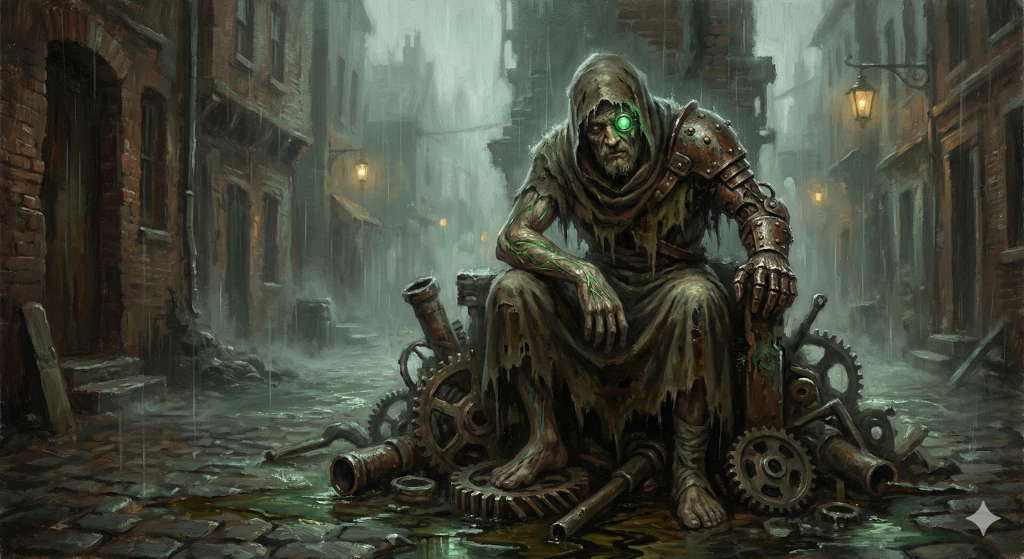
He saw a monster. Half man, half wreckage. Silas’s left side was a sculpture of industrial debris—rivets where pores should be, plates of iron overlapping like fungal growth. His eye was a green lantern in the dark.
“You,” the Enforcer sneered behind his brass mask. “Scrap-eater. Did you swallow it?”
He swung the truncheon. It was a practiced blow, meant to shatter a collarbone, to incapacitate.
Silas did not dodge. He did not have the agility. He simply existed in the path of the blow. He was the wall against which the wave breaks.
The oak club connected with Silas’s shoulder.
CRACK.
It was a sickening sound. Not the bone. The wood. The truncheon splintered against the iron plating, sending shards flying into the muck.
The Enforcer stared at his broken weapon, then at his stinging hands. He took a step back, confusion warring with bravado.
Silas moved. It was a slow, grinding motion, unstoppable and heavy. He reached out with his iron hand. The metal joints creaked, a sound of ancient machinery waking up. He clamped his fingers onto the Enforcer’s wrist.
“Let go!” the man shrieked, striking at Silas’s face with his free fist.
The fist connected with Silas’s jaw. Silas felt the skin of his right cheek tear, a flap of flesh hanging loose. But beneath it, the jawbone was solid lead. The Enforcer screamed as his knuckles shattered against the unyielding surface.
Silas squeezed. He didn’t mean to crush the wrist, but he was calibrated for heavy lifting now, for bearing the weight of the world.
The radius snapped with the sound of a dry branch.
The Enforcer dropped to his knees, wailing.
The other Enforcers froze. They looked at the beggar, at the glowing green veins pulsing in his neck, at the steam rising from his metallic skin where the rain hit it.
“Leave,” Silas said. The voice was unrecognizable—it was the grinding of tectonic plates, deep and resonant.
They scrambled back, dragging their wounded comrade, their discipline shattered by the impossible density of the creature before them. They disappeared into the fog, leaving only the echo of their boots.
Silas looked at his hand. It was stained with blood, but none of it was his. He felt no triumph. Only the cold, hard certainty that he was no longer human enough to bleed. He turned to Magda. She looked at him with empty eyes, seeing only a shape, not a savior.
Chapter 4
She came the next night.
The Sump went quiet. Even the rats seemed to hold their breath. The air grew still, the smog parting for a procession of wealth.
A phalanx of private guards, wearing the Vane crest—a hawk gripping a coin—cleared a path through the filth. They carried electric pikes that hummed with menace.
Lady Elara Vane walked in the center. She was a vision of purity in a cesspool. She wore a dress of white silk that seemed to repel the grime of the district, hovering inches above the muck. Her hair was piled high, pinned with diamonds. She held a scented handkerchief to her nose, her eyes scanning the debris with disdain.
Silas sat on a mound of compressed trash—broken crates, rusted gears, wet cardboard. It was a throne of refuse for the King of Dross.
He watched her with his one good eye. The other was a lens of green glass, fused into an iron socket.
“You are a difficult thing to find,” Elara said. Her voice was musical, sharp and clear, like a silver bell ringing in a graveyard. “And a difficult thing to look at.”
Silas said nothing. He sat immobile, letting the weight of Lord Vane’s death radiate from him. He knew she could feel it. The guilt was a broadcast signal.
Elara stepped closer, her guards tensing. She signaled them to stand down with a wave of her gloved hand. She reached into a small velvet pouch at her waist.
“You have something of mine,” she said. “A mistake. A moment of weakness. I wish to correct it.”
She pulled out a coin.
It shone with a light so pure, so white, it hurt to look at. It cast long, sharp shadows in the alley.
Platinum.
“A Platinum Blank,” she whispered, holding it up like a holy wafer. “Do you know what this is, creature?”
Silas knew. The ultimate currency. It didn’t contain a memory. It contained the absence of one. It was a localized wipe. A reset button. A forgiveness that didn’t require penance, only erasure.
“One touch,” Elara promised, her voice dropping to a seductive purr. “And the pain goes away. The iron stops spreading. The voices stop whispering. You will be clean. You will be new. You can leave this place. You can buy a house in the Upper Wards. You can have a name again.”
Silas looked at the Platinum Blank. He could feel its pull—a vacuum waiting to suck the agony out of his marrow. To sleep without the screams of drowning children. To walk without dragging a leg of rusted steel. To be warm again. To feel the sun on flesh, not the rain on metal.
It was the greatest temptation he had ever known.
But then the voices rose.
Justice, Lord Vane whispered in his shoulder. Mama, the drowning child wept in his kidney. Hungry, the old woman Magda coughed in the shadows nearby.
He looked at the people peering out from their hovels. The broken, the empty, the dross. They were the landfill for people like Elara. She ate the joy and shat the misery onto them.
If he took the Blank, the gold would be erased. The murder would be gone. Elara would be free, her conscience scrubbed clean, ready to fill more coins with more victims. She would kill again. She would consume again.
Silas looked at Elara. He saw the fear behind her eyes. It was a small, frantic thing, beating against the bars of her arrogance. She wasn’t offering him mercy. She was buying his silence. She was afraid of the judgment he carried.
He looked at his iron hand. It was ugly. It was cold. It was hard. It was true.
“No,” Silas said.
Elara blinked, her smile faltering. “Excuse me?”
“The pain,” Silas rumbled. He stood up, the trash shifting beneath his weight, avalanching down the sides of his mound. “It is… necessary.”
“You fool,” Elara hissed, the mask slipping, revealing the snarling predator beneath. “You are rotting alive. You are becoming a statue in a sewer. Take the exit! Take the mercy!”
“I am not rotting,” Silas said. He took a step down from his throne. The ground shook. “I am remembering. Someone has to.”
Elara’s face twisted into a rictus of hate. “Kill it. Cut the coin out of him. Melt him down to slag.”
The guards moved with professional efficiency. There were four of them, armed with monofilament blades capable of slicing through diamond. They moved in a coordinated pattern, a kill-box formation.
The first guard lunged, a blur of motion, thrusting the blade at Silas’s chest.
It sparked. A shower of yellow fire against the dark iron. The blade skittered off Silas’s ribs, leaving a scratch but failing to penetrate the density of the accumulated sin.
Silas did not strike back with a fist. He did not use violence. He used the only weapon he had left.
He reached out and laid his open palm against the guard’s face.
CONTACT.
Silas opened the floodgates. He didn’t just remember; he shared. He pushed the Lead Slug of the drowning child into the guard’s mind, amplifying it with the resonance of his iron body.
The guard’s eyes rolled back. He gasped, clutching his throat, his lungs filling with phantom water. He fell, thrashing in the mud, drowning in the open air, his mind submerged in a river of ice.
The second guard swung a mace. It clanged against Silas’s shoulder, denting the metal but not breaking the structure. Silas grabbed the man’s arm. The touch was gentle, almost intimate.
CONTACT.
He unleashed the memory of a factory fire he had eaten three years ago. The heat. The smell of burning hair. The trapped screaming of workers locked behind chained doors.
The guard screamed with them, clawing at his own skin to put out invisible flames, falling to his knees, his mind blistering.
The other two guards hesitated. They looked at their fallen comrades—one drowning, one burning. They looked at the towering figure of rust and green light. They were mercenaries. They were paid to fight men, not nightmares.
Silas walked past them. They backed away, terrified of his touch, terrified of the truth he carried.
Elara stood alone. The white silk was splattered with mud now. She looked small. She drew a pistol—a sleek, chrome thing, beautiful and deadly. Her hand shook.
“Stay back!” she shrieked. “I command you!”
She fired.
The gun cracked. The bullet hit Silas in the center of his chest.
It mushroomed against the sternum plate. There was no magic, no transmutation. Just the physics of soft lead hitting hard iron. The bullet flattened into a useless disc and fell to the ground with a tiny ting.
Silas didn’t break stride. He was inevitable. He was the consequences she had tried to outrun. He was the entropy of her own soul coming home to roost.
Elara backed up until she hit the brick wall. There was nowhere left to go. She looked at him, and for the first time, she saw herself reflected in his iron face.
“What do you want?” she sobbed, sliding down the wall. “Money? I have gold! I have diamonds! I have land!”
Silas stopped inches from her. He towered over her, a monolith of rust and judgment. The green light from his veins cast her face in a ghoulish, underwater pallor.
“I do not want your money,” Silas said. His voice was a multitude—the child, the husband, the burned workers, the starving beggars. “I want to give you a refund.”
He raised his iron hand. The Blighted Gold memory surged within him, hot and poisonous, demanding release. He concentrated, channeling it, moving it from his core to his fingertips.
“No,” Elara whispered, her eyes widening. “No, please. I can’t take it back. I can’t live with it!”
“It is yours,” Silas said. “You cannot buy forgiveness.”
He pressed his thumb against her forehead.
The scream that tore from Lady Elara’s throat was not human. It was the sound of a soul fracturing, the sound of a psyche shattering under a weight it was never meant to bear.
The memory of the murder did not return as a gentle recollection. It crashed into her with the force of the iron that held it.
She felt the weight of the goblet in her hand. She tasted the poison on her own tongue. She saw the betrayal in her husband’s eyes, magnified a thousand times by Silas’s empathy. She felt his confusion, his fear, his death. But worse, she felt her own coldness. She felt the hollowness of her victory. She saw herself as she truly was—a monster in silk.
She slumped to the ground, clawing at her head, weeping, gagging on the guilt she had paid a fortune to excise. Her mind broke, fracturing into a million shards of sharp, cutting regret.
Silas stepped back.
The discharge of the memory was the final catalyst.
The heat left him. The last patch of flesh on his right cheek turned gray, then silver, then dark, dull iron. His legs locked. His arms settled at his sides.
The need to breathe vanished. The hunger vanished. The beating of his heart slowed, then stopped, replaced by the stillness of the stone.
He was heavy. So incredibly heavy.
He sat down in the mud, his back against the wall, legs crossed in a posture of eternal meditation. He closed his eyes—one glass, one iron.
He could still hear the city. He could hear the sobbing of Lady Elara as she crawled away into the dark, a broken thing. He could hear the wind whistling through the tenements. He could hear the distant chatter of the Upper Wards.
But the pain was gone. The constant, gnawing hunger was gone.
He was the anchor. He was the vault. He was the Dross Collector, and he was full.
Epilogue
The fog swirled around the statue in the alley.
It had been months, perhaps years. Time meant little to iron. The figure sat motionless, covered in a layer of soot and bird lime. Rust had begun to streak the iron flanks, orange tears running down the unmoving face, tracing the path of sorrows long absorbed.
Lady Elara was gone—mad, they said, locked in an asylum in the Upper Wards, screaming about wine and dead eyes, tearing at her own skin to get the poison out.
But the people of the Sump remained.
A young girl approached the statue. She was thin, her clothes ragged, her eyes large and dark. She held a flower—a yellow dandelion pushing up through a crack in the pavement. A weed to some, a miracle to others.
She didn’t have a coin. She didn’t have a memory to sell. She didn’t have fear.
She placed the flower on the statue’s knee.
“Thank you,” she whispered.
She reached out and touched the iron hand. It was cold, freezing against her skin, but it didn’t feel dead. It felt solid. It felt permanent. It felt like the only thing in the city that couldn’t be bought, couldn’t be sold, couldn’t be moved.
Deep inside the casing, in the core of the machine that had once been a man, a single spark of green light pulsed.
Once.
Twice.
A heartbeat of memory.
Silas waited. He was the Dross Collector, and his work was done. He sat, heavy and eternal, guarding the conscience of a city that had none.