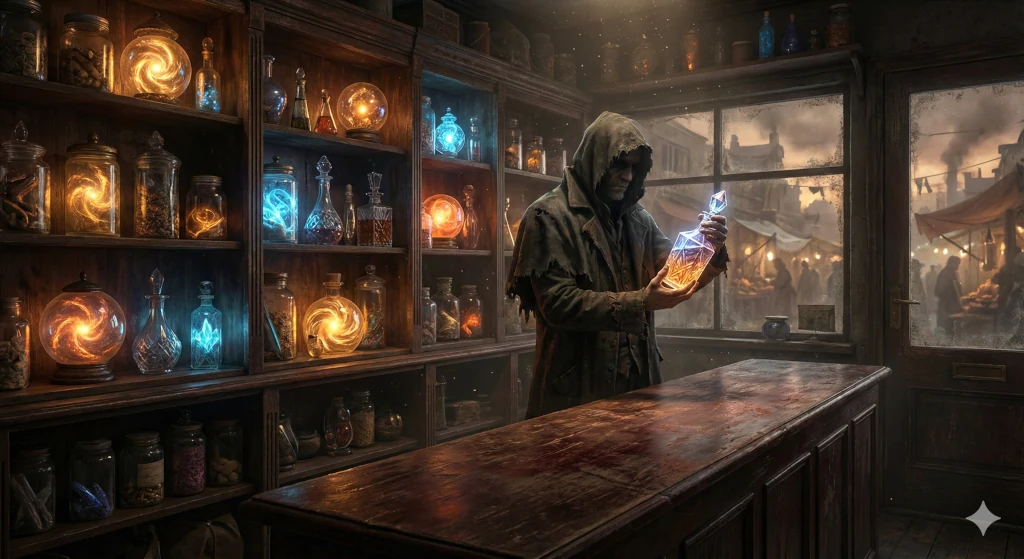
The jar labeled ‘First Triumph’ was heavy in the Broker’s hands, a leaden vessel that vibrated with a hum like a trapped wasp. It smelled of ozone and the sharp, metallic tang of fresh blood—the scent of victory seized rather than given. The artist, a man whose coat hung from his shoulders like a shroud of damp moss, reached out with trembling fingers.
“Careful,” the Broker warned, his voice like gravel shifting in a dry riverbed. “It is volatile stock. Do not shake the asset.”
The artist nodded, his eyes wide and hungry, reflecting the amber luminescence swirling within the glass. He placed the payment on the counter: three vials of distilled Euphoria, glowing with a neon pulse that felt warm against the wood.
The transaction concluded with the slide of glass across mahogany. As the artist shuffled out into the smog-choked alley of the Bazaar, clutching his new history to his chest, the Broker uncorked one of the payment vials. The scent of vanilla and sun-baked stone wafted up—high-grade currency. He began to inventory his gains, a satisfied warmth spreading through his chest. Instinctively, he reached back into the archives of his own mind, seeking a similar resonance—the memory of his own first major sale, the day he had proven his father wrong.
His mental fingers grasped at air.
The shelf was bare. Where the memory should have been—a solid, golden brick of pride—there was only a smooth, cold void. It was not a fading; it was an excision. A specific, random hour of his timeline had been liquidated.
The Broker stood frozen in the dim shop, the air thick with the smell of dust and dried lavender. He looked at the empty space on the shelf behind the counter where ‘First Triumph’ had sat, and then inward at the hole in his own past. The ledger balanced with terrifying precision. To sell the highest quality stock was to strip the assets from one’s own soul. A deficit had been incurred.
He resolved immediately to freeze all high-value trading. Preservation of the remaining inventory—his self—was paramount.
But the Bazaar did not tolerate stagnation. Two days later, the Landlord’s agent arrived. The creature smelled of wet ash and rattled when it moved.
“Rent is due,” the agent rasped, tapping a long, skeletal finger on the glass counter. “Five ounces of Wonder. Pure.”
The Broker checked his reserves. He was insolvent. The jars of Wonder were depleted, sold during the lean winter months.
“I can offer Contentment,” the Broker negotiated, gesturing to a row of dusty, grey jars. “Sturdy goods. Reliable.”
The agent sneered, the sound like tearing canvas. “Contentment is cheap filler. The market is saturated with mediocrity. We require Wonder. Or we liquidate the storefront.”
The threat hung in the air, heavy and suffocating as a wool blanket. The agent left with a rattling warning, leaving the Broker alone with his depreciation.
He looked at the grey jars of Contentment. They felt like clay in his hands—dull, cool, lifeless. He tried to hawk them to the passersby, shouting over the din of the market.
“Routine! Routine for sale! The comfort of a Tuesday afternoon! The safety of a predicted outcome!”
The shoppers hurried past, their eyes glazed, seeking sharper highs. No one wanted the grey sludge of safety. The Broker stood in the doorway for hours, the weight of the unsold inventory pressing against his back like a physical wall. The grey jars seemed to multiply in the shadows, a surplus of mediocrity that threatened to bury him. Every hour the sun sank lower, the interest on his debt compounded. He was drowning in low-value assets.
A shivering client entered as the evening fog rolled in. She was wrapped in layers of rags, yet she shook with a bone-deep cold.
“Warmth,” she whispered. “I need… warmth.”
The Broker looked at the grey jars. Useless. He looked to the upper shelves, where the premium stock glowed. His gaze landed on a sphere of radiant orange glass: ‘Perfect Summer Day.’ It radiated heat that he could feel from across the room, smelling of cut grass and melting ice cream.
He hesitated. The deficit. What would this cost?
The memory of the agent’s rattle echoed in the silence. Eviction meant the dissolution of the enterprise. Bankruptcy was not an option.
“This is a premium asset,” the Broker said, his voice tighter, less adorned. He placed the sphere on the counter. It seared the wood.
The woman paid in raw Nostalgia—a handful of silver coins that felt like polished river stones. The Broker pushed the summer day across. She cracked the seal and inhaled. The shivering stopped.
The Broker blinked. A face he had known for twenty years—the curve of a jaw, the specific shade of brown eyes, the sound of a laugh in a rainstorm—vanished. It was his first love. He knew he had loved someone; he knew there had been a person who mattered. But the image was gone, replaced by a flat, white silence.
He waited for the grief. It did not come. Instead, he felt a sudden lightness, as if a heavy ledger had been closed. The emotional overhead was gone. The debt was cleared. It was a clean transaction, a necessary balancing of the books. The panic he expected was absent. Instead, a cool, efficient numbness settled in. The rent was paid. The business survived.
The numbness was efficient. It decluttered the operations.
The bell above the door chimed. A man in a silk suit entered. He carried himself with the heavy, frantic energy of a man running out of time, smelling of stale champagne and panic. He placed a heavy briefcase on the counter.
“I require ‘A Mother’s Forgiveness’,” the man said. “I am dying. I cannot go with this weight.”
The Broker stood still. He possessed this item. It was the centerpiece of his collection, kept in a crystal decanter that felt like fragile eggshell and smelled of rain on hot pavement and soft, powdery perfume.
He looked at the decanter. He performed the valuation. This was a Tier 1 asset. The cost of goods sold would be total. The extraction would likely target the founding capital: the memory of why he had opened this shop. The origin. The motivation.
If he sold it, he would not know why he was here.
He looked at the briefcase. The man opened it. Inside were bars of pure Fulfillment. Solid, heavy, immutable gold. Enough to retire. Enough to cease all operations.
The Broker looked at the decanter. He looked at the gold.
The metaphor of the soul was inefficient. This was a balance sheet. The origin story was a sunk cost. The gold was liquid capital.
He reached out. His hand did not tremble. He picked up the decanter. It was just glass and chemical fluid.
“The price is as stated,” the Broker said.
“Agreed,” the man said.
The exchange was made. The man drank the forgiveness and wept, his shoulders dropping inches as the burden dissolved. He left the shop light as a feather.
The Broker counted the gold. It was correct. He locked the briefcase.
He stood in the center of the room. The shelves were lined with jars. He verified the inventory levels. They were adequate.
He looked at the counter. There was a small metal object there. A locket.
He picked it up. It was cold, hard metal. He opened it. There was a small picture inside of a woman.
He looked at the face. It was a stranger.
He examined the object for defects. The hinge was functional. The metal was tarnished silver. It had some resale value.
He took a small white tag and a pen. He wrote a price on the tag. He tied the tag to the locket.
He placed the item in the display case, next to the other goods. He sat on his stool and waited for a customer.
The shop was quiet. The air smelled of dust. The ledger was balanced.