The Shadow’s Ledger
Elias’s apartment was a study in vacuum. Eggshell white walls. Brushed steel. Polished glass. No photographs cluttered the surfaces. No dust gathered in the corners. He lived in the present, a clean line between yesterday and tomorrow.
He stood by the floor-to-ceiling window. The city below was a grid of light. He turned to walk toward the kitchen.
His shadow stayed.
It was only a fraction of a second. A glitch in the physics of the room. Elias stopped. He looked back at the floor. The dark shape was now perfectly aligned with his feet, anchored by the cold LED overhead. He moved his arm. The shadow followed.
He dismissed it. He was tired. The mind, when deprived of friction, creates its own.
The next morning, the residue appeared.
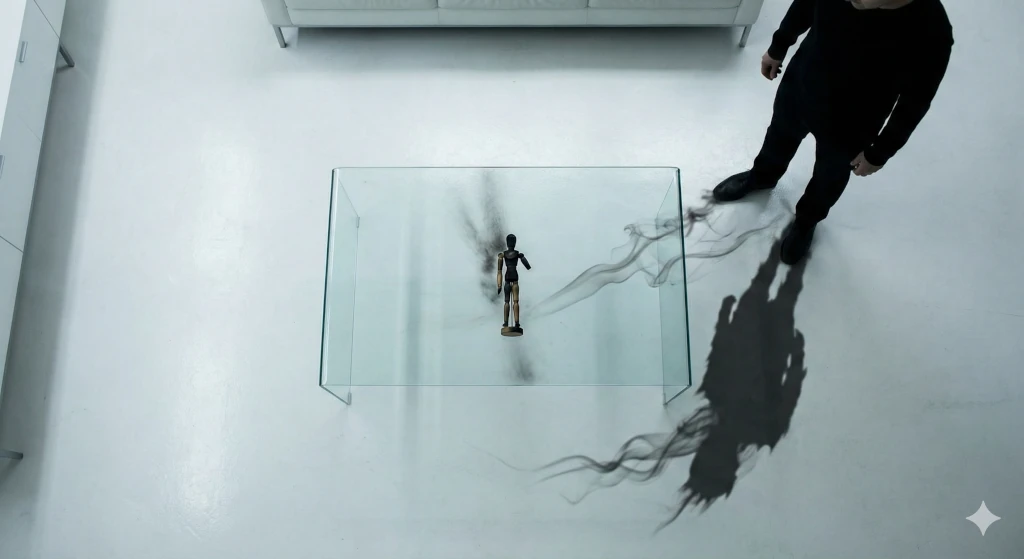
It sat on the polished granite of the kitchen island. A small, charred wooden soldier. One arm was missing. The smell of combustion—stale, old, and sharp—clung to it. Elias did not touch it. He had no such toy. He had sanitized his history years ago.
He swept the thing into the trash with a piece of cardboard. He refused to touch the charcoal-black wood.
At the office, the discrepancy grew. Elias was mid-sentence in a briefing when his shadow reached out. It didn’t mimic his gesture. It reached for the neck of the colleague sitting beside him. The shadow’s fingers were too long, tapering into points that felt anatomically wrong.
The colleague flinched, rubbing his neck. Elias went still. His own hands were folded on the table. The shadow remained in a choking posture, a phantom limb of a memory he refused to name.
“Is there a draft?” the colleague asked.
Elias looked away. “The HVAC system is out of alignment.”
He hurried home. The city felt constricted, the glass towers pressing in like the walls of a narrowing throat. The silence of his apartment, once a sanctuary, now felt like a held breath. He turned on every light. The sterile glow should have flattened everything, but the shadow was heavy. It had its own mass. It didn’t just fall across the floor; it seemed to sink into it.
It began the pantomime.
In the corner of the room, the shadow detached its back from Elias’s heels. It began to claw at the white drywall. It wasn’t Elias’s shape anymore. It was smaller. A child’s silhouette. It was screaming—a silent, bone-deep tremor that Elias felt in his teeth.
The smell arrived then. Not the sterile air of the high-rise, but the thick, oily smoke of the East End apartments. Julian.
Julian had been eight. Elias had been eight. Playing with matches in the closet. The wooden soldiers. The coats. The orange glow. Heat—a living thing, a hungry thing. Elias had run. He hadn’t looked back. He told the firemen he was outside. He told himself he hadn’t heard the calling. The screaming.
The shadow was reenacting the closet now. Reaching out. A dark hand stretching toward a smaller, flickering shape on the wall. Julian’s hand.
Elias killed the lights. He wanted the darkness to erase the debt.
But the shadow persisted. A darker black against the night. It grabbed his ankle. The touch was cold, like ice that burns. Not a pull. A weight. An anchor.
He couldn’t stay. He ran.
He drove toward the old district. The city’s texture shifted. Smooth, sound-dampening glass surrendered to abrasive brick. The hum of the tires turned to a rhythmic thrum, then a jarring rattle on the cracked pavement. The air grew thick, heavy with the scent of wet ash and neglected earth. The overgrown lot waited, a gap-toothed snarl in the skyline.
The weight on his heels was unbearable. Friction. Resistance.
The shadow moved ahead of him. It stretched across the cracked pavement, growing until it hit the foundation of the old building. It began to play the night back.
Elias watched the shadow-version of himself. Small. Fast. Cowardly. It ran toward the edge of the lot, toward safety. Behind it, the shadow-Julian was trapped. Reaching through the phantom window of a house made of memory and smoke.
“I wasn’t there,” Elias whispered. His voice was thin against the wind.
The shadow stopped. It turned its head. It had no face, yet Elias felt the accusation. The shadow stepped toward him. Jerky. Skipping frames. A film reel catching on a sprocket. It reached out, mimicking the desperate reach Julian had made thirty years ago.
Elias felt the heat then. Not the sun. The furnace-breath of the closet. The combustion of thirty years of lies. The air became a solid thing, a wall of pressure.
He didn’t run. He stepped forward. Into the dark space. Into the friction. Heat met cold. Sterile met soot.
Hand to hand. Breath to smoke. The weight of the closet. The roar of the fire. The silence of the betrayal.
“I left you,” Elias said. The words were stones dropped into a deep well. “I heard you, and I ran.”
The shadow froze. The jagged, wrong proportions of its limbs softened. It began to shrink, to settle. The heat faded, replaced by the damp chill of the night.
The shadow snapped back. It aligned with his feet, a simple, dark reflection.
Elias stood in the center of the vacant lot for a long time. He felt the weight of his own body. He was no longer a clean line.
He drove back to the city.
The apartment was still white, but it no longer felt empty. He took the charred wooden soldier out of the trash. He set it on the glass coffee table. It left a smudge of soot on the surface. A dark mark on the perfection. He didn’t wipe it away.
He picked up his phone. He had the number for Julian’s sister. A phantom contact he had kept for years.
He sat on the sofa. His shadow was there, resting quietly on the rug, perfectly in sync. It was heavy, and it was his.
He pressed ‘call’.