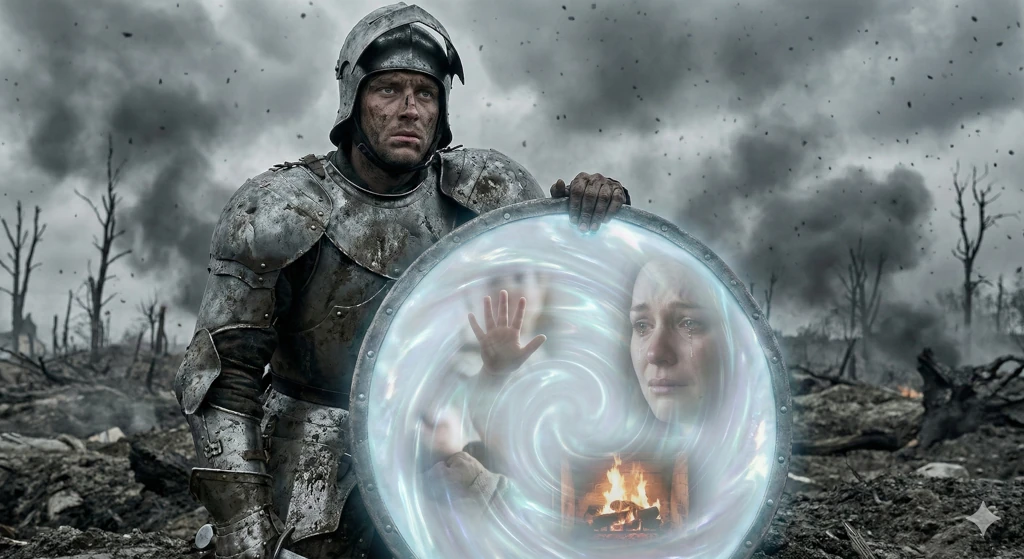
The Shield of Echoes
Kaelen’s arm did not ache, and that was the first lie. The shield was a slab of liquid moonlight, a gossamer weight that felt more like a suggestion of protection than a wall of steel. He had found it in the ruins of a temple that smelled of ozone and forgotten prayers, its surface a shifting fog that refused to hold his reflection. He was tired. His bones were brittle from a decade of iron-on-iron, his marrow hollowed out by the constant, thrumming fear of the next blow. He took the shield because it promised a silence he had never known.
The first time he used it, the world broke. A scavenger’s rusted blade descended toward his shoulder, a strike that should have bitten deep. There was no jar, no vibration of impact. Instead, the air curdled into the taste of overripe peaches, the cloying, fermented sweetness coating his tongue like a thick syrup. His nostrils filled with the sharp, acidic bite of lye soap and the heavy, humid scent of wet wool drying by a hearth. For a heartbeat, he wasn’t on a muddy ridge; he was six years old, laughing as a woman with calloused, flour-dusted hands ruffled his hair.
The scavenger stumbled back, eyes wide with a confusion Kaelen didn’t yet understand. Kaelen felt a shimmering, stolen nostalgia for a life he never lived. He returned to camp without a single bruise, his skin unmarred, but his mind felt heavy, as if a fine, grey silt had begun to settle at the base of his skull.
The war didn’t stop, and neither did the shield.
With every skirmish, the sediment thickened. An arrow deflected by the translucent surface didn’t clatter; it blossomed into the salt-sting of tears and the grainy, lukewarm texture of cold porridge. A mace-swing against his flank became the suffocating, humid heat of a crowded barracks and the metallic, stinging tang of fear-sweat. Kaelen became a vacuum, a vessel for the discarded fragments of other men’s souls.
He was invincible. The villagers called him the Iron Ghost, but Kaelen found he could no longer taste the ale. It was always overshadowed by the phantom flavors of the shield—stale bread, bitter herbs, the coppery residue of someone else’s blood.
He returned home to Elara—or at least, he thought her name was Elara. When she touched his face, her skin felt like parchment, dry and distant. “Kaelen?” she whispered. He looked at her and saw three different women. One was Elara, another was a girl from a mountain village, and the third was an old woman mourning a lost cow. “Sari,” he said, the name tasting like ash and lavender. “No, Myna. I… I am here.” The dialect was thicker, the vowels elongated in a way that belonged to the northern provinces, the very people he was supposed to be fighting.
He was a ghost in his own house. The memories were viscous now, an oily shimmer coating his thoughts. He would sit by the fire and suddenly feel the crushing grief of a father who had lost his daughter to the fever, or the sharp, jagged pride of a young boy catching his first fish. His own childhood—the real one—was a fraying thread, a gossamer thing easily lost in the cacophony of a thousand other lives.
Then came the bridge at Oakhaven.
Varyn stood across from him, a man who had once shared Kaelen’s bread. Now, Varyn wore the colors of the rebellion, his face a mask of desperate resolve. “Move, Kaelen,” Varyn said. Kaelen raised the shield. The surface was no longer translucent; it was becoming opaque, a dark, roiling grey that hummed with a low, dissonant frequency. Varyn lunged. The sword struck the shield’s center.
The impact was a flood. Kaelen didn’t feel the force of the blow, but he felt Varyn’s soul leach into him. It tasted of pine needles and woodsmoke. It smelled of a secret, shameful relief that the war might finally end. He saw Varyn’s reason for betrayal—a daughter held hostage, a village burned by the very king they served. The memories were a jagged overlap of loyalty and terror.
Kaelen’s arm felt leaden, not from the weight of the metal, but from the weight of the man. To kill Varyn would be to consume the rest of him, to add the final, crushing volume to the sediment in his mind. Kaelen stepped aside. He couldn’t speak; his tongue was tangled in three different languages, none of them his own. Varyn ran past, and Kaelen stood alone, the shield vibrating against his arm like a trapped bird.
The siege of the capital was the end of the world.
Kaelen stood at the breach. The last line. The air was a static of screams and smoke. The shield was black now. Dense. A shimmering mass of stored lives. It felt ready to explode. Every weapon strike brought a fresh wave of dissonance.
(Rain on hot stone. Metallic. Sharp.) (A first kiss, sour with cheap wine and the smell of hay.) (The heavy, wool-scratch weight of a winter coat.) (The rhythmic, dull sting of a needle through thick leather.)
He was drowning. His own name was a flicker in the dark. He was everyone and no one. He was a thousand soldiers, a hundred widows, a dozen dying children. The memories were a shimmer, a bleed of colors that blinded him to the reality of the mud beneath his feet.
A young soldier, barely a man, scrambled over the rubble. His eyes were wide, clean, and terrified. He held a spear with trembling hands. Kaelen looked into those eyes and saw a void—a life not yet consumed, a mind not yet broken by the shield.
The boy screamed and lunged.
If Kaelen raised the shield, he would know the boy’s first love. He would taste his mother’s cooking. He would feel the weight of the boy’s fear until it became his own. And in that moment, the last fragment of Kaelen—the man who loved Elara, the man who remembered the smell of the temple ozone—would splinter and vanish. He would be a vessel of echoes, an immortal husk of borrowed ghosts.
Kaelen looked at the shield. It was a beautiful, terrible lie.
He unbuckled the straps. He let the shimmering, liquid mass slide from his arm. It hit the mud with a soft, wet sound, its surface dulling instantly, the light within it fading to a leaden grey.
The spear took him in the shoulder.
The pain was a revelation. It was sharp, jagged, and gloriously, terrifyingly real. It was a white-hot anchor that tore through the oily, iridescent film of the memories. The heat of his own blood. The raw, grinding scrape of iron against bone. The sudden, overwhelming pulse of his own heart. It was a tether. A homecoming.
Kaelen fell. The physical reality of the ground was hard and cold. The mud was grit between his teeth, not the taste of peaches or porridge. The agony in his shoulder was his own. It belonged to no one else.
The cacophony in his head went silent. The ghosts fled, unable to compete with the visceral, screaming truth of his own body. The dialects, the griefs, the secret shames—they all evaporated like mist under a mid-day sun.
He lay in the mud, gasping. The battle raged around him, a storm of iron and fire, but for the first time in years, it was quiet. He was Kaelen. His shoulder was a ruin of heat and bone, but he was Kaelen.
A few feet away, the shield lay abandoned. It was just a piece of metal now, its magic spent or perhaps simply waiting for the next man who was too tired to bleed. The surface was dark and silent, reflecting only the grey, soot-choked sky.
Kaelen closed his eyes. The pain was heavy, a grounding weight that held him to the earth. He was scarred, broken, and bleeding.
He was finally alone.