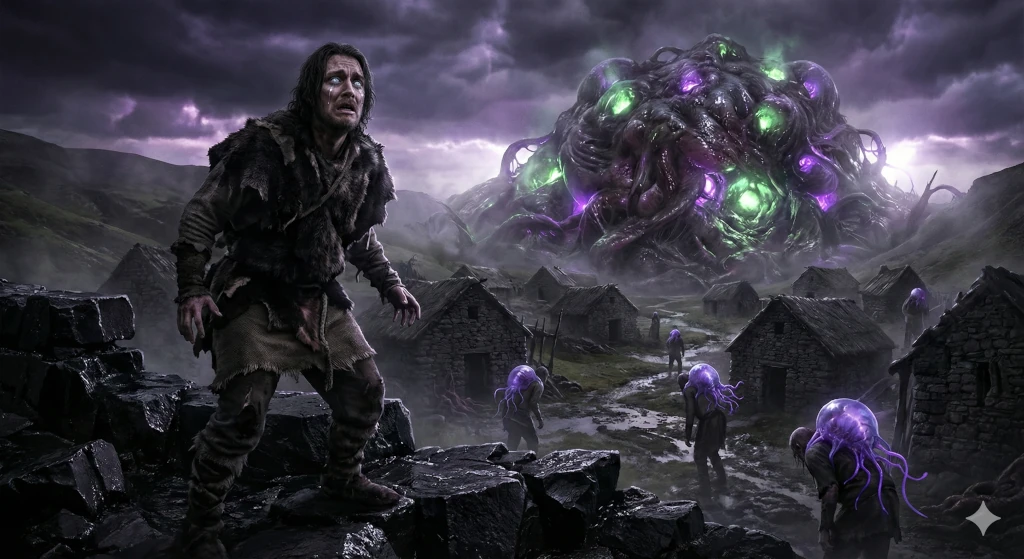
The wind tasted of copper and coming rain. Kael shifted his weight on the stone rampart, the rough grit of the basalt scraping against his calloused soles. To his left, the steady, rhythmic thump-drag of Elder Maren’s pacing marked the edge of the sanctuary. Above them, the Great Ones slept, their holy presence manifesting as a low, wet thrum in the rock, a vibration that smelled faintly of sweet musk and safety. It was the heartbeat of the valley, constant and reassuring.
“Quiet night,” Maren rasped, the sound vibrating in Kael’s chest.
“Too quiet,” Kael replied. The vibrations of his own voice felt flat, swallowed by the heavy air. “The cicadas have stopped.”
It wasn’t silence, exactly. The world was never silent. It was a tapestry of hums, clicks, shifts, and breaths. But the texture had changed. The usual chaotic weave of the forest below had smoothed into a tense, waiting sheet.
Then came the smell. Not the ozone of the storm, nor the sweet musk of the Gods. This was sharp. Acrid. Like spoiled milk and burning hair.
“Intruders,” Kael hissed, unslinging his spear. The ash-wood shaft was smooth in his grip, a familiar extension of his arm.
“Where?” Maren stopped pacing.
“Below. Climbing.”
Kael didn’t need eyes to aim. He felt the disturbance in the air currents, the displacement caused by bodies moving where only wind should be. He lunged, thrusting the spear downward into the void. It struck meat. A wet tear, a gasp, and the heavy slide of a body falling away.
But there were more. Too many more.
The invasion didn’t come with war cries. It came with a soft, wet splattering sound, like mud slapped against a wall. Kael swung his spear again, but something caught the shaft. A hand. Too hot. Fever-hot.
He twisted, aiming a kick, but a palm slammed against his forehead. It didn’t strike with force; it pressed, sticky and searing.
“Witness,” a voice whispered. It wasn’t a language Kael knew, yet the meaning drilled directly into his skull, bypassing his ears entirely. “The cage breaks.”
The pain was immediate. It wasn’t the dull ache of a bruise or the sharp line of a cut. It was an explosion behind his brow, a tearing of the delicate curtain that kept the world in order. Kael screamed, dropping his spear to clutch at his face.
The darkness, his eternal, comforting mother, shattered.
It began as jagged lines of agonizing, screaming sensation, searing through the calm black. Shapes assaulted him—horrible, impossible geometries that had no texture, no sound, only this screaming intensity of existence. The sensory overload made him retch. He fell to his knees, clawing at his eyes, but the torture wasn’t coming from outside. It was inside.
“Breathe, Kael!” Maren’s voice was a panic he’d never heard before.
Kael tried to orient himself by the sound, but the sight overwhelmed it. He turned his head and the chaos smeared, sensations bleeding into one another like fresh wounds. He saw a shape—a looming, blurry blotch of dry-rot texture where Maren’s voice originated.
“Maren?” Kael croaked.
The blotch moved. The sickness in Kael’s head sharpened, focusing the agony into clarity. The dry-rot thing wasn’t a man. It was a husk. A withered, desiccated thing wrapped in rags. But attached to its back, pulsing with a deep, bruised radiance that felt like a migraine made visible, was a bloat. A massive, translucent sack of fluid, throbbing in time with the holy rhythm Kael had worshiped his entire life.
Tendrils, thin as spider silk but glowing with that same sickly heat, burrowed from the sack into the base of Maren’s skull.
“Kael, fight them!” Maren shouted, but Kael watched the sack contract, pumping a dark sludge into the Elder.
Kael scrambled back, the rough stone scraping his skin, but the tactile sensation was drowned out by the visual horror. He looked up. The village square, usually a place of echoing warmth and familiar stone textures, was a charnel house of light.
Every villager, every friend and neighbor, bore the burden. They ran, they fought the invaders, and on every back rode the shimmering, bruised-fruit parasites. The creatures were bulbous, trembling with gorged greed, their tendrils woven deep into spines and skulls.
And above the temple, where the Great Ones were said to sleep in holy silence?
There was no stone structure. There was only a writhing mountain of flesh, a colossal, pulsating heart of deep, suffocating rot that fed on the tethers connecting it to every villager below. The “blessings” they felt—the warmth, the guidance—were waste heat. Digestion. The sweet musk he loved was the stench of their excretion.
The invaders—tall, smooth-skinned figures with faces wrapped in cloth—were not killing. They were cutting the tethers.
One of the fever-hot strangers stepped toward Kael. The figure raised a blade that didn’t sing through the air but shimmered with a dull, matte finish.
“Do not fear the pain,” the stranger said, the words sharp and cold. “It is the only truth.”
Kael looked at his own hands. They were caked in dirt, trembling. And wrapping around his own forearms, disappearing up toward his shoulders, were the faint, glowing traces of where the tendrils had been trying to take root, burned away by the infection of sight.
He looked at Maren again. The Elder was swinging his club wildly at the stranger. The parasite on Maren’s back rippled, its colors shifting from that deep bruise-tone to a screaming, feverish heat. It was piloting him.
“Monster!” Kael screamed, but he wasn’t looking at the stranger.
The stranger stepped past Kael, the blade flashing. With a wet severing sound, the connection between Maren and the parasite was severed. Maren collapsed, screaming, not in pain, but in a sudden, hollow silence.
The parasite fell to the stones, thrashing, a fish out of water, hideous and exposed.
Kael squeezed his eyes shut, praying for the darkness to return, for the simple, honest world of stone and wind and sound. But the burning images remained, seared onto the back of his eyelids. The world was not a cradle. It was a larder.
He opened his weeping eyes. The headache pounded a new rhythm, a drumbeat of revelation. He picked up his spear. The stranger offered a hand, but Kael ignored it.
He turned his face toward the temple, toward the pulsating mountain of gluttonous flesh that he had once prayed to. The Stranger was just a breaker of chains; the enemy was the master of the house.
Kael tightened his grip on the ash-wood shaft. The comfort was dead. And he had a god to kill.